Timeline
The same events read three ways: as a ruler against real calendar dates, as a chart of where the book departs from that calendar, and as a handful of plain lists for when a chart is more than the question needs. Find it in the binder sidebar's Story Bible section, under Analysis, or in the Analysis menu.
Seven tabs, one set of events
Every tab draws from the same events, dates and chapters — Visual, Story Time, Manuscript, Order, Arc Beats, Flashbacks and Braid are seven different readings of one dataset, not seven separate ones. The scope row beneath the tabs — which manuscript, which character, which location — applies to whichever tab is showing, and a filter left of the row marks it as a filter rather than a second title bar.
Detect Dates, top right on every tab, scans the manuscript prose for calendar dates and — separately — infers a birth year from a stated age ("she turned eleven that spring") against a character's own known birthday. Either can add entries the ruler and chart below didn't have a moment ago; a toast reports what it found and jumps you to Story Time to see it. If a scan run turns up nothing, it says so rather than staying silent.
When two entries land on the same real-world date but can't both be true — a character in two places at once, travel that couldn't have happened in the time given — an orange banner appears above the ruler naming each conflict. Click one to open the record it's about.
Visual — the ruler
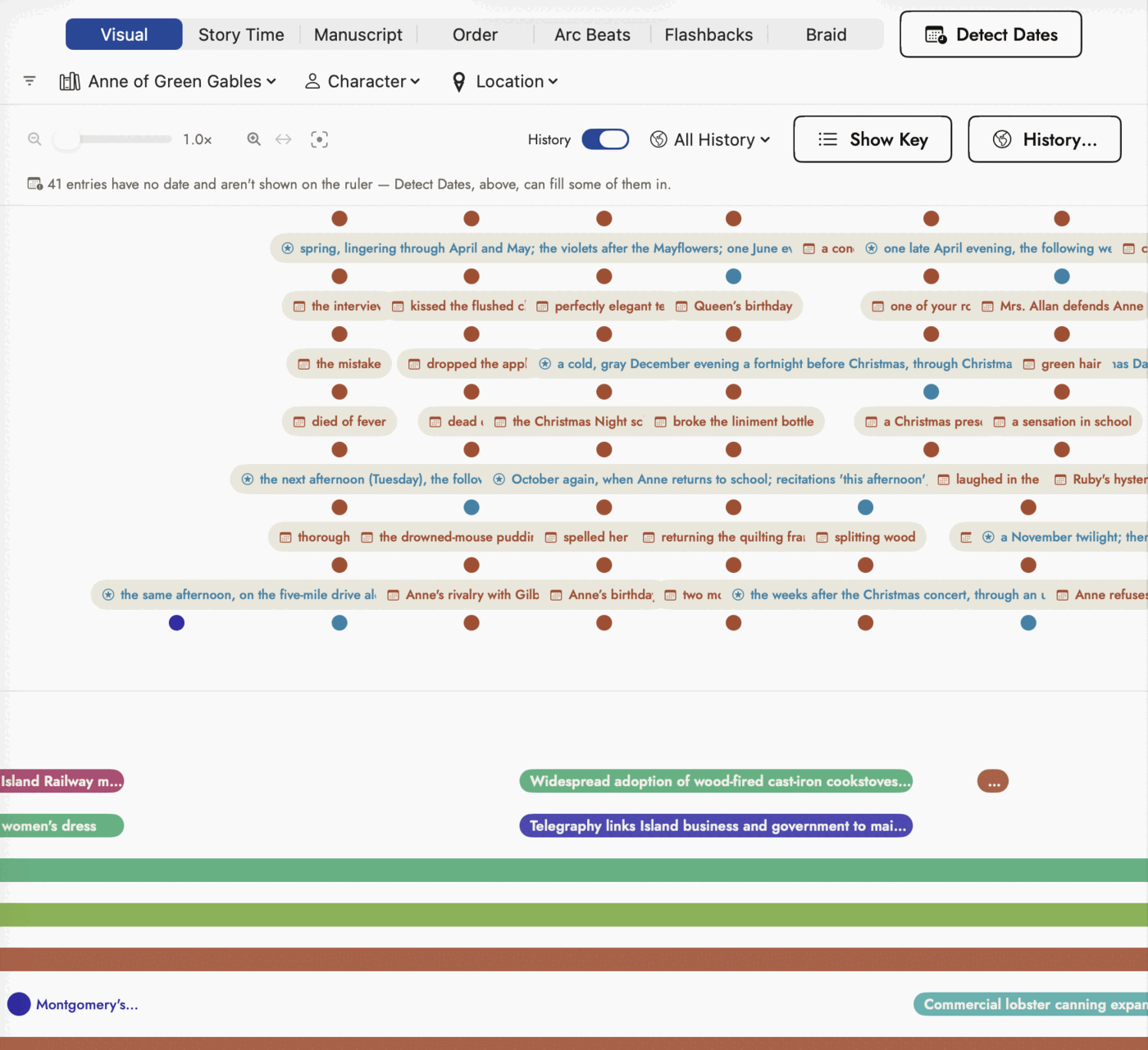 Story entries above the axis, History's reference band
below it, both mapped against the same dates.
Story entries above the axis, History's reference band
below it, both mapped against the same dates.
Oldest on the left, newest on the right. Each dot or pill is one dated entry — a chapter, a scene, an event, a character's birth or death, a story arc's beat, a plot thread opening or closing — coloured by its own entity type, the same colours used everywhere else in the Story Bible. A pill's width is a known duration (an event with both a start and an end); everything else is a point. Entries with no date at all aren't on the ruler — the notice just under the toolbar says how many, and that Detect Dates can find some of them.
The band beneath is History: real-world events you've imported, typed in, or had AI help build, drawn on the identical axis so a chapter set in October 1970 sits directly above what was actually happening that October. Toggle it off with the History switch, open its colour-coded legend with Show Key, or jump to the importer with the History… button. See History for building that band up. When more than one research set has been imported, a menu next to the switch — labelled All History by default — narrows the band to just one of them, so a Twain-era timeline and an unrelated pop-culture one don't have to share a single pile of dots. The two bands scroll vertically on their own — scrolling through a long run of story entries doesn't carry History off the bottom of the screen, or the other way round — but stay locked together horizontally, so date alignment between them never drifts.
The row above the ruler zooms and reframes it: the slider stretches the axis toward finer ticks — years, then months, days, hours, minutes — without narrowing what's shown; Focus (the scope icon, once a project has dated chapters or scenes) actually narrows the window to one chapter or scene, so combining the two is what reaches hour-level spacing. The dot-in-a-box button recentres on wherever the bulk of the story's own dates actually cluster — not a plain midpoint, which a single outlying flashback or a birth decades before the main action would otherwise drag the view toward. Click any marker to open a small card for it; hovering a History marker opens its card too, after a short pause, so dragging across a busy band doesn't flash a dozen popovers on the way past.
Braid — where the book flashes back
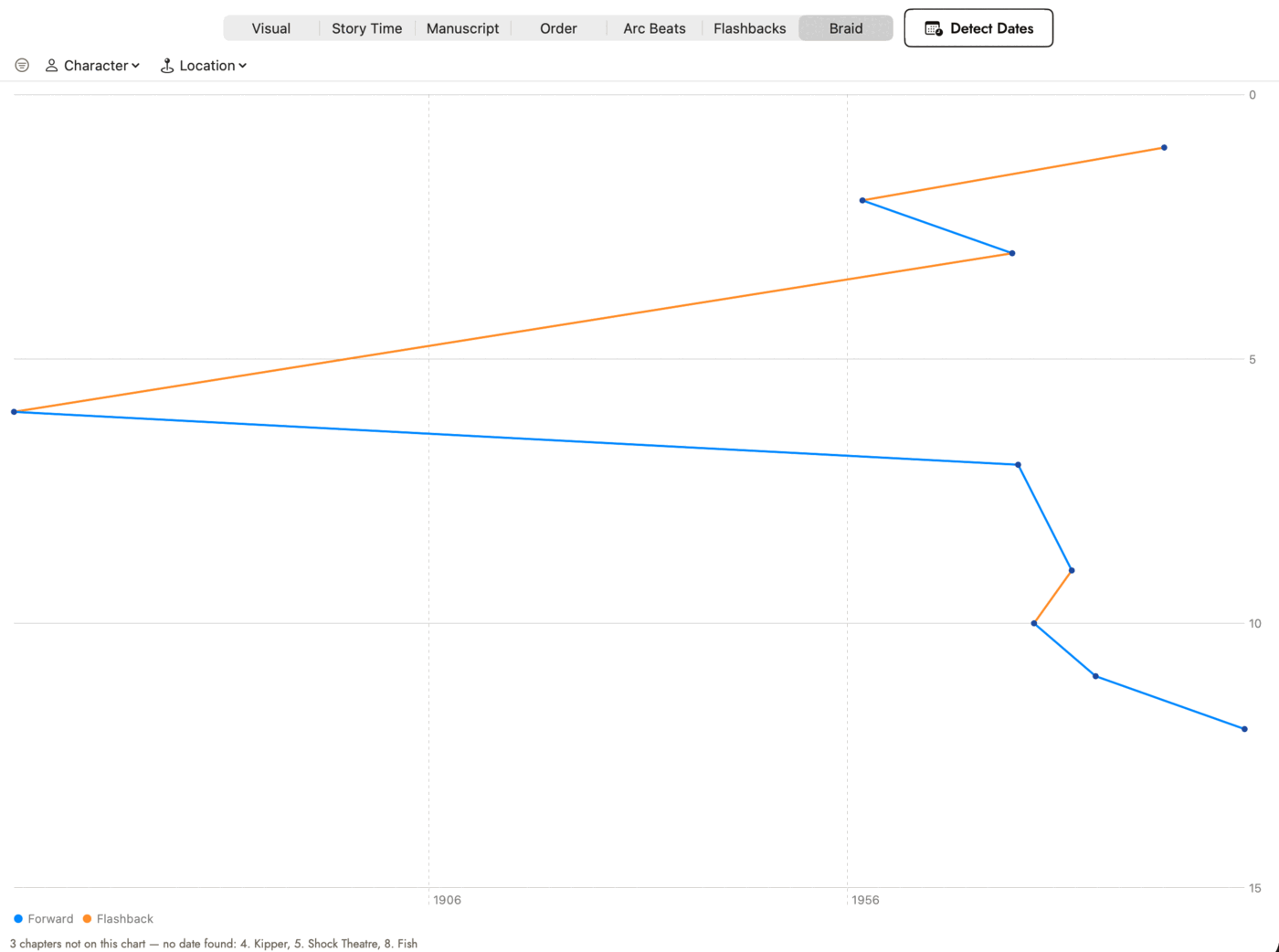 Blue runs forward in time; every orange segment is a
place the manuscript flashes back before moving on.
Blue runs forward in time; every orange segment is a
place the manuscript flashes back before moving on.
One dot per dated chapter. The horizontal axis is the real date it's set on; the vertical axis is where it sits in the book, chapter one at the top. A line connects the dots in the order a reader actually meets them, coloured by the legend at the bottom left: Forward where the next chapter is set later than the one before it, Flashback where it jumps backward. A flash-forward shows the same way, just the other direction: a spike ahead in time, then the Flashback-coloured segment that snaps back when the book resumes its normal march — the zigzag itself is the point, more than either colour on its own. A smaller dot marks a chapter whose date was worked out from its own scenes rather than set on the chapter directly; a full-size dot has its own date. Chapters with no date at all aren't plotted — they're named underneath the chart instead of silently missing, the same principle as the Visual tab's undated notice.
The other five tabs
Story Time and Manuscript are the same entries as flat, scrollable lists — sorted by calendar date and by reading order respectively — for skimming or searching rather than looking at shape. Order lists events without a firm date and lets you drag them into a narrative sequence by hand, for the stretches Detect Dates has nothing to find. Arc Beats shows one story arc's beats in sequence, picked from a menu. Flashbacks is Braid's own zigzag as a list instead of a chart — every entry where story-time order and manuscript order disagree, worded as which it is and linked straight to the record.